The Problem
Network timeouts, crashes, and accidental window closures kill your session context. Re-establishing it in a new window wastes time and tokens.
Session 1:  Deep in a complex refactor — network drops               ✗ context gone
New session: "What were we working on?" — 10 minutes re-explaining   ✗ expensive
The Solution
fireworks-sessions-saver automatically tracks what you're working on in Claude Code and makes it instantly available when you reconnect. The same checkpoint and restore scripts are also usable from Codex today.
Session 1:  Working on auth refactor → auto-tracked every tool call
            Network drops
New session: "Found 1 previous session — restore?" → one keystroke   ✓ back in 5 seconds

Codex:      Save a checkpoint explicitly → restore from the same scripts later  ✓ usable today
Install
In Claude Code or Codex, just say:
"Install fireworks-sessions-saver from https://github.com/yizhiyanhua-ai/fireworks-sessions-saver"
How It Works
Architecture
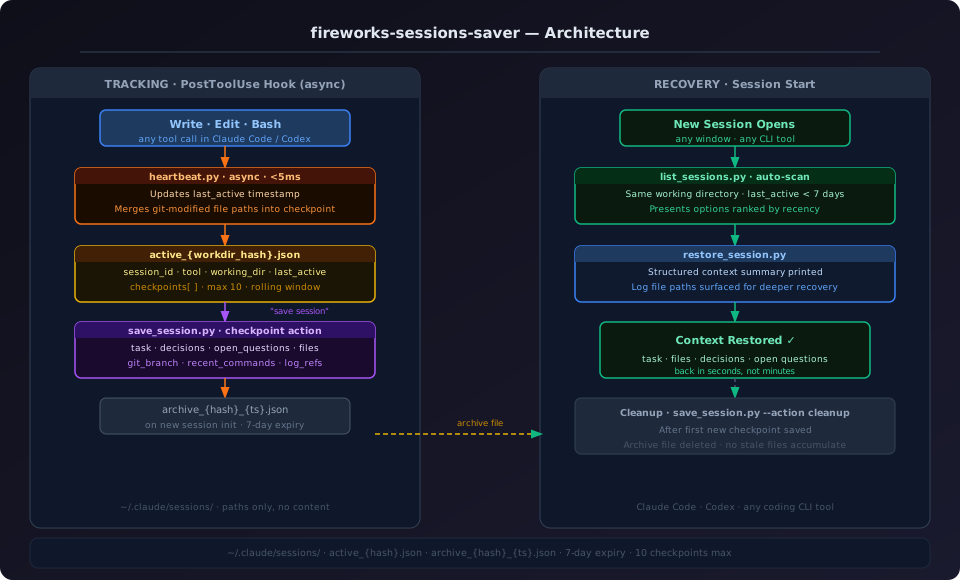
Left — Tracking flow: Every Write, Edit, or Bash call fires heartbeat.py asynchronously (<5ms), updating last_active and merging git-modified file paths into the active session file. When you say "save session", a rich checkpoint is written — capturing the current task, key decisions, open questions, file references, git branch, and log paths. On the next session init, the active file is archived.
Right — Recovery flow: When a new session opens, list_sessions.py automatically scans for sessions in the same working directory active within the last 7 days. After you select one, restore_session.py prints a structured context summary. Once the first new checkpoint is saved, the archive file is deleted — no stale files accumulate.
Components
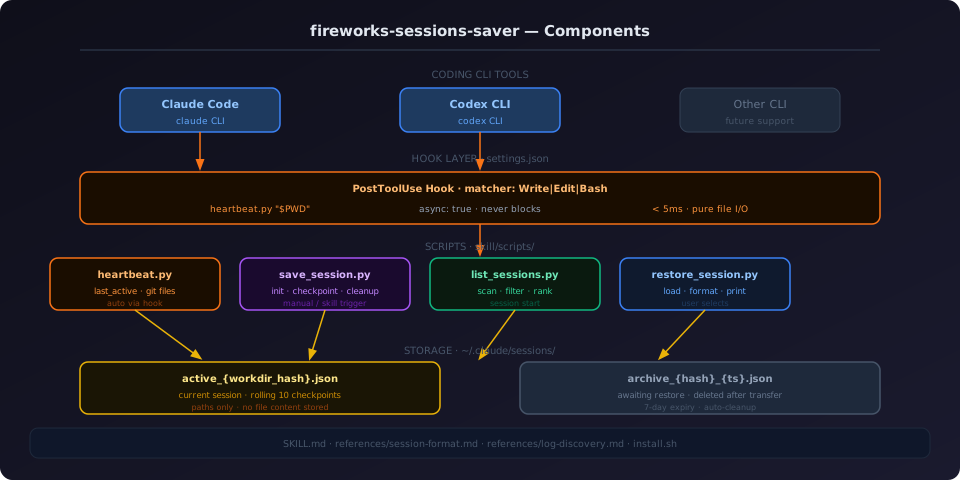
Four layers, top to bottom:
- CLI Tools — Claude Code is fully automated today; Codex already supports the manual scripts; the architecture is open to any coding CLI.
- Hook Layer — A single
PostToolUse hook in settings.json fires heartbeat.py asynchronously after every file write or shell command in Claude Code. Zero impact on your workflow.
- Scripts — Four focused Python scripts:
heartbeat.py (auto, lightweight), save_session.py (init / checkpoint / cleanup), list_sessions.py (scan & rank), restore_session.py (format & print).
- Storage — Two JSON file types in
~/.claude/sessions/: active_{hash}.json for the running session (rolling 10 checkpoints), and archive_{hash}_{ts}.json for sessions awaiting restore or expiry.
Usage
Automatic (via hook)
The heartbeat runs silently after every Write, Edit, or Bash call. No action needed.
Save a rich checkpoint
Say any of:
save session / save progress保存进度 / 保存状态
Claude will capture: current task, files in context, key decisions, open questions, recent commands, and log file paths.
Restore a previous session
In a new window, Claude automatically checks for recoverable sessions on startup. Or say:
restore session / continue from last session恢复会话 / 继续之前的工作
View all sessions (dashboard)
Say any of:
dashboard / show all sessions / which projects are active查看所有 session / 多项目看板
Claude will run the dashboard and show all active sessions across every working directory.
# Manual CLI usage
python3 ~/.claude/skills/fireworks-sessions-saver/scripts/dashboard.py
python3 ~/.claude/skills/fireworks-sessions-saver/scripts/dashboard.py --all   # include expired
Diff two checkpoints
Say any of:
diff checkpoint / what changed since last checkpoint对比进度 / 两次 checkpoint 有什么变化
Claude will compare the last two checkpoints and show what changed in task, files, decisions, and open questions.
# Manual CLI usage
python3 ~/.claude/skills/fireworks-sessions-saver/scripts/diff_session.py \
  --session-file ~/.claude/sessions/active_<hash>.json
python3 ~/.claude/skills/fireworks-sessions-saver/scripts/diff_session.py \
  --session-file ~/.claude/sessions/active_<hash>.json --list   # list all checkpoints
python3 ~/.claude/skills/fireworks-sessions-saver/scripts/diff_session.py \
  --session-file ~/.claude/sessions/active_<hash>.json --from 2 --to 4
Manual CLI usage
# List recoverable sessions for current directory
python3 ~/.claude/skills/fireworks-sessions-saver/scripts/list_sessions.py

# Restore a specific session
python3 ~/.claude/skills/fireworks-sessions-saver/scripts/restore_session.py \
  --session-file ~/.claude/sessions/archive_abc12345_20260408_143022.json
Codex today
Codex does not expose Claude-style hooks, so the recommended flow is explicit:
# Save a rich checkpoint from the current Codex working session
python3 ~/.claude/skills/fireworks-sessions-saver/scripts/save_session.py \
  --working-dir "$(pwd)" \
  --tool "codex" \
  --action checkpoint \
  --summary "Brief current status" \
  --current-task "Specific task in progress"

# Later, scan and restore from the same working directory
python3 ~/.claude/skills/fireworks-sessions-saver/scripts/list_sessions.py "$(pwd)"
python3 ~/.claude/skills/fireworks-sessions-saver/scripts/restore_session.py \
  --session-file ~/.claude/sessions/archive_<hash>_<timestamp>.json
Storage
~/.claude/sessions/
  active_{workdir_hash}.json          ← current active session
  archive_{workdir_hash}_{ts}.json    ← archived (awaiting restore or expiry)
- Sessions expire after 7 days of inactivity
- Each file holds at most 10 checkpoints (rolling window)
- Only file paths are stored — never file contents
- Archived files are deleted after successful transfer to a new session
Requirements
- Python 3.9+
- Claude Code CLI for hook-based auto-tracking
- Codex CLI for manual checkpoint / restore workflows
- macOS / Linux
Codex CLI: Hook-based auto-tracking is not yet supported (Codex does not have a hook system). Manual checkpoint, dashboard, diff, and restore via the scripts already work today. Full auto-tracking is on the roadmap.
Roadmap
Project Structure
fireworks-sessions-saver/
├── skill/
│   ├── SKILL.md                      ← Claude Code skill definition
│   ├── references/
│   │   ├── session-format.md         ← JSON schema docs
│   │   └── log-discovery.md          ← Claude Code / Codex log locations
│   └── scripts/
│       ├── save_session.py           ← init / checkpoint / cleanup
│       ├── list_sessions.py          ← find recoverable sessions
│       ├── restore_session.py        ← print structured context summary
│       ├── heartbeat.py              ← lightweight async hook
│       ├── diff_session.py           ← diff two checkpoints
│       └── dashboard.py              ← multi-project session dashboard
├── install.sh
├── LICENSE
├── README.md
└── README.zh-CN.md
Contributing
PRs welcome. Please open an issue first for significant changes.
License
MIT