The Problem
Every coding-agent session starts from zero. The same mistakes repeat — wrong API parameters, broken sequences, proxy pitfalls — because the runtime has no durable skill memory between sessions.
Session 1:  "Don't forget — use index=0 for Feishu blocks"   ✓ works
Session 2:  same mistake again                                ✗ forgot
Session 3:  same mistake again                                ✗ forgot
The Solution
fireworks-skill-memory gives Claude Code and Codex a persistent, skill-scoped memory that grows smarter with every session. The storage layer is shared; the hook and flush flows are runtime-specific.
Session 1:  mistake happens → lesson saved automatically
Session 2:  lesson injected before Claude responds            ✓ no repeat
Session 3:  lesson still there, more lessons added            ✓ keeps improving
Install
Claude Code
In Claude Code, just say:
"Help me install fireworks-skill-memory from https://github.com/yizhiyanhua-ai/fireworks-skill-memory"
Or run directly in your terminal:
curl -fsSL https://raw.githubusercontent.com/yizhiyanhua-ai/fireworks-skill-memory/main/install.sh | bash
Then type /hooks in Claude Code to activate. No config files to edit manually.
Codex
Codex does not use Claude-style hooks. The current integration path is explicit and runtime-driven:
python3 cli/skill_memory.py inject --skill lark-sync
python3 cli/skill_memory.py checkpoint --skill lark-sync --note "..."
python3 cli/skill_memory.py flush --skill lark-sync --summary-file ./session-summary.md
Codex memory defaults to:
$CODEX_HOME/memories/fireworks-skill-memory/
Architecture
End-to-End Flow
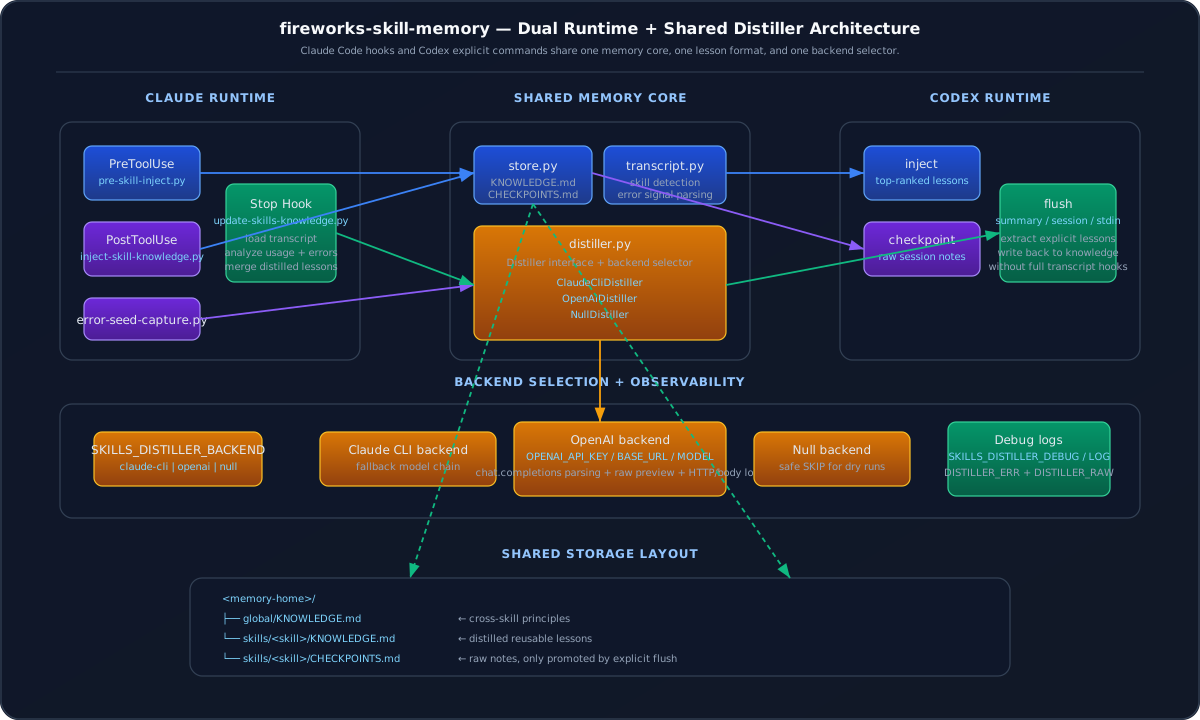
Two runtimes, one shared memory core:
| Hook |
Event |
Job |
PreToolUse (Skill) |
Before any Skill call |
Inject past lessons before execution — Claude plans with experience, not after mistakes |
PostToolUse (Read) |
When Claude reads a SKILL.md |
Inject past lessons into context — < 5ms, pure file I/O |
PostToolUse (all tools) |
After every tool call |
Capture error signals to session-scoped seed file — broader coverage |
Stop (async) |
When a session ends |
Distil 1–3 new lessons from transcript via haiku — non-blocking |
Stop (async, daily) |
Once per day at session end |
Check remote repo for updates, notify at next SessionStart if available |
SessionStart |
When a session begins |
Show pending scheduled task notifications + update alerts |
Codex currently uses explicit commands instead of hooks:
| Runtime |
Entry point |
Job |
Codex |
inject |
Prefix a task with the top ranked skill lessons |
Codex |
checkpoint |
Save raw notes under the skill directory for later distillation |
Codex |
flush |
Distil explicit lessons from summary/session sources back into KNOWLEDGE.md |
Runtime Split
memory_core/
  store.py           # skill/global knowledge storage, merge, eviction
  transcript.py      # transcript parsing helpers

runtimes/
  claude_runtime.py  # Claude transcript provider + Claude CLI distiller
  codex_runtime.py   # Codex checkpoint/flush provider

scripts/             # thin Claude hook adapters
cli/                 # thin Codex/manual adapter
Distillation is now behind a shared interface. The Claude runtime currently uses the ClaudeCliDistiller backend; Codex explicit flows remain local until you attach another backend.
The backend selector lives in memory_core/distiller.py. OpenAIDistiller now has stronger real-world debugging support: it parses more OpenAI-compatible response shapes, records structured HTTP/body failures, and emits raw-response previews through SKILLS_DISTILLER_DEBUG or SKILLS_DISTILLER_LOG.
v4 harness optimizations (2026-04-05):
- Observability — every Stop hook execution is logged to
~/.claude/skill-memory.log (timestamp, session, skills, result)
- Broader error coverage — new
error-seed-capture.py captures errors from ALL tool calls, not just SKILL.md reads
- Earlier injection — new
pre-skill-inject.py fires on PreToolUse, so Claude sees lessons during planning
- Model fallback chain — if primary haiku model is deprecated, automatically tries next available model
- Cross-session usage stats —
skill-usage-stats.json tracks per-skill usage frequency for smarter eviction
- Larger knowledge base —
SKILL_MAX / GLOBAL_MAX expanded from 30/20 to 100 entries each
- Context-efficient injection — active invocations inject top-20 by HIT count, not full file
Harness Engineering Pattern
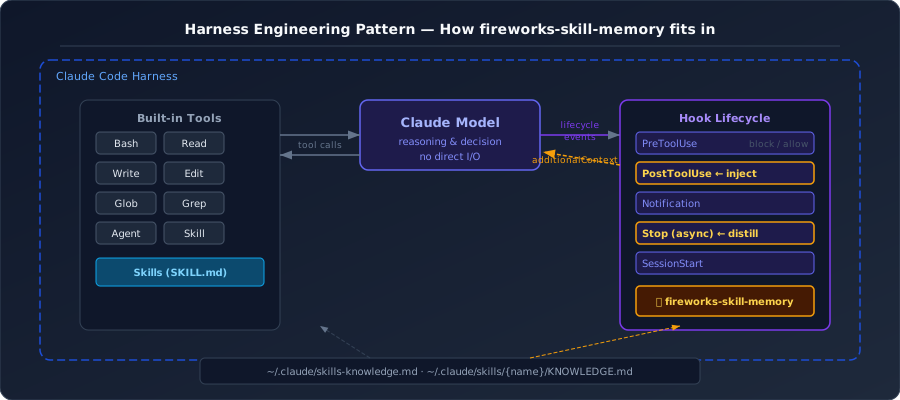
Claude Code's Harness is the orchestration layer between the model and the world — the model only reasons, while Harness handles all I/O: tool calls, file access, subprocess execution, permission enforcement. fireworks-skill-memory is a pure Harness-layer extension: it never modifies the model, never touches your prompts, and never intercepts user input.
It operates on exactly two lifecycle hook points that the Harness exposes:
PostToolUse on Read — fires when any SKILL.md is read, injects additionalContext into the model's context windowStop with async: true — fires after every session completes, runs the distillation pipeline in the background without blocking
This is the correct engineering pattern for extending Claude Code: hook into the Harness lifecycle, not into the model itself.
Knowledge Structure
<memory-home>/
├── global/KNOWLEDGE.md          ← global cross-skill principles
└── skills/
    ├── browser-use/
    │   ├── KNOWLEDGE.md         ← distilled skill-specific lessons
    │   └── CHECKPOINTS.md       ← raw runtime notes, not injected by default
    └── {any-skill}/
        ├── KNOWLEDGE.md
        └── CHECKPOINTS.md

Legacy Claude runtime state remains under `~/.claude/`:
~/.claude/skills/<skill>/KNOWLEDGE.md
~/.claude/error-seeds/<session_id>.txt
~/.claude/skill-memory.log
~/.claude/skill-usage-stats.json
Two-layer design:
- Global — principles that help across all skills
- Per-skill — precise, actionable lessons scoped to that skill only
Context injection is scoped: only the relevant skill's file loads, keeping the model's context window clean.
What Gets Remembered
Example entries that accumulate over real usage:
# browser-use — experience

- [2026-03] [state before acting] Always run `browser-use state` before clicking —
  indices change after every page interaction. Never reuse a stale index.
- [2026-03] [daemon lifecycle] Run `browser-use close` when done. The daemon stays
  open and holds resources until explicitly closed.
- [2026-02] [auth via profile] Use --profile "Default" to access sites where you're
  already logged in. Headless Chromium has no saved cookies.
Included Starter Knowledge
Ready-made lesson files for Claude Code's official skills are included out of the box. Codex can read the same lessons through the shared memory core or Claude fallback paths.
| Skill |
Pre-loaded lessons |
find-skills |
CLI commands, install paths, network error patterns |
skills-updater |
Two update sources, version tracking, locale detection |
voice |
agent-voice setup, auth flow, ask vs say semantics |
browser-use |
state-before-act, daemon lifecycle, profile auth |
skill-adoption-planner |
Fast-path inputs, resistance diagnosis |
skill-knowledge-extractor |
No-script mode, pattern types |
skill-roi-calculator |
Minimum data, comparison mode |
hookify |
Rule format, regex field, naming conventions |
superpowers |
Mandatory invocation, user-instruction priority |
Privacy & Security
|
Detail |
| 📍 Data location |
Everything stays on your machine — no cloud, no uploads |
| 📄 Transcript access |
Claude runtime reads local Claude JSONL transcripts; Codex runtime currently uses explicit summary/session inputs |
| 🔑 Secrets |
Distillation prompt explicitly excludes credentials and personal data |
| 🤖 API calls |
Claude distillation runs through your existing Claude Code auth; Codex explicit flows stay local unless you add a model backend |
See SECURITY.md for the full security policy.
Configuration
All optional. Set in ~/.claude/settings.json under "env":
| Variable |
Default |
Description |
SKILLS_KNOWLEDGE_MODEL |
claude-haiku-4-5 |
Default model for the Claude CLI distiller backend (falls back automatically if deprecated) |
SKILLS_DISTILLER_BACKEND |
claude-cli |
Distiller backend selector: claude-cli, openai, or null |
SKILLS_DISTILLER_DEBUG |
unset |
When set to 1/true, write backend debug logs to ~/.claude/skill-memory-distiller.log |
SKILLS_DISTILLER_LOG |
unset |
Optional explicit path for distiller debug logs |
SKILL_MAX |
100 |
Max entries per skill file |
GLOBAL_MAX |
100 |
Max entries in the global file |
TRANSCRIPT_LINES |
300 |
Lines of transcript to analyse |
SKILLS_KNOWLEDGE_DIR |
~/.claude/skills |
Root of skill directories |
SKILLS_INJECT_TOP |
20 |
Max entries injected on active skill invocation (sorted by HIT count) |
SKILLS_SEEDS_DIR |
~/.claude/error-seeds |
Directory for session-scoped error seed files |
SKILLS_STATS_FILE |
~/.claude/skill-usage-stats.json |
Cross-session skill usage statistics |
SKILLS_MEMORY_LOG |
~/.claude/skill-memory.log |
Stop hook execution log path |
When using the openai backend, also set:
| Variable |
Default |
Description |
OPENAI_API_KEY |
none |
API key for the OpenAI distiller backend |
OPENAI_BASE_URL |
https://api.openai.com/v1 |
Base URL for OpenAI-compatible chat completions |
OPENAI_MODEL |
gpt-5.4 |
Model name for the OpenAI distiller backend |
For real debugging, enable either:
SKILLS_DISTILLER_DEBUG=1SKILLS_DISTILLER_LOG=/absolute/path/to/distiller.log
Codex Runtime
Shared storage defaults to:
$CODEX_HOME/memories/fireworks-skill-memory/   # when running inside Codex
~/.ai-memory/                                  # otherwise
Directory layout:
<memory-home>/
├── global/KNOWLEDGE.md
└── skills/
    └── <skill>/KNOWLEDGE.md
Legacy Claude skill knowledge under ~/.claude/skills/<skill>/KNOWLEDGE.md is still read as a fallback.
Use the CLI directly:
python3 cli/skill_memory.py inject --skill lark-sync
python3 cli/skill_memory.py checkpoint --skill lark-sync --note "Feishu local image embeds must be uploaded first"
python3 cli/skill_memory.py flush --skill lark-sync --summary-file ./session-summary.md
python3 cli/skill_memory.py flush --skill lark-sync --session-file ./codex-session.jsonl
cat session-summary.md | python3 cli/skill_memory.py flush --skill lark-sync --stdin
python3 cli/skill_memory.py show --skill lark-sync
Recommended summary format for flush:
# Session Summary

## Lessons

- Verify effective scopes before wiki writes
- `docs +create` does not resolve Obsidian local image embeds
- Replace `![[...]]` with `<image token="..."/>` before overwrite sync
Current commands:
inject — prints a plain-text experience block suitable for prefixing into a Codex taskcheckpoint — appends raw session notes under the skill directory for later distillationflush — distils at most 3 explicit lessons from a summary file, session export, or stdin into KNOWLEDGE.md; it only reads lesson-style sections such as ## Lessons, ## Takeaways, or ## 经验沉淀. Checkpoints stay separate unless --include-checkpoints is passedshow — prints the current KNOWLEDGE.md for a skill, with Claude fallback support
Codex remains explicit by design for now: distilled knowledge is loaded progressively per skill, while raw notes stay in CHECKPOINTS.md until you intentionally flush them.
Contributing
Contributions of new starter KNOWLEDGE.md files for popular skills are especially welcome.
- Fork and branch:
git checkout -b feat/skill-name-knowledge
- Add your file to
examples/skill-knowledge/
- Open a PR — describe what lessons are included and why they matter
License
MIT © 2026 yizhiyanhua-ai