Working Notes on Agent Systems/Brad Zhang

@teach_fireworks / X longform

Claude Sonnet 4.5 and Opus 4.1 start to support structured output! The benefits are sel...

Claude Sonnet 4.5 and Opus 4.1 start to support structured output! The benefits are self-evident, developers no longer have to deal with the trivial manual work of structuring C...

November 15, 2025 · 1 min read

Claude Sonnet 4.5 and Opus 4.1 start to support structured output! The benefits are sel...
Figure 1 / source image

Claude Sonnet

  • 5 and Opus 4.1 start to support structured output! The benefits are self-evident, developers no longer have to deal with the trivial manual work of structuring Claude API responses themselves. Basically, most tasks can be accomplished through Claude SDK and http api. With structured output, developers can eliminate schema-related parsing errors and failed tool calls by ensuring that Claude's responses conform to defined schemas—whether extracting data from images, coordinating agents, or integrating with external APIs. For developers building applications and agents in production environments, a single error in the data format can cause cascading failures. Structured output solves this problem by guaranteeing that your response matches the exact structure you define, without any impact on model performance. This makes Claude trustworthy in applications and agents where accuracy is critical, including:
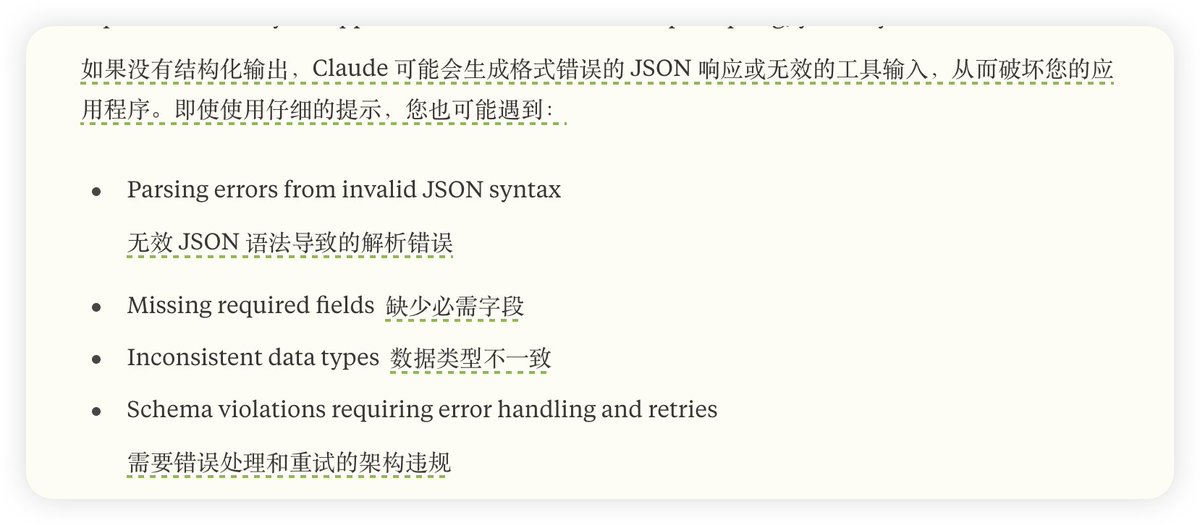
  • When downstream systems rely on error-free, consistent formats for data extraction. 2 In a multi-Agent architecture, consistent communication between agents is crucial to achieve high performance and stable experience. 3 Complex search tools where multiple search fields must be filled in accurately and conform to specific patterns. Figure 1 is the previous problem, Figure 2 is the current definition output structure, Figure 3 is the supported JSON operation symbols
Figure 2 / source image

Visual summary

Article argument map

Generated from the post's content graph

FORMATTOPICCAPABILITYMARKETcoverscoverscoverscoverssignalssignalssignalsFORMATlongform noteTOPICagentsTOPICtechnical distributionTOPICretrievalTOPICtoolingCAPABILITYagent workflowCAPABILITYdeveloper toolingCAPABILITYproduct surface
Mermaid outline
flowchart LR
  format-long_post["longform note"]
  topic-agents["agents"]
  topic-technical-distribution["technical distribution"]
  topic-retrieval["retrieval"]
  topic-tooling["tooling"]
  capability-agent-workflow["agent workflow"]
  capability-developer-tooling["developer tooling"]
  capability-product-surface["product surface"]
  format-long_post -->|covers| topic-agents
  format-long_post -->|covers| topic-technical-distribution
  format-long_post -->|covers| topic-retrieval
  format-long_post -->|covers| topic-tooling
  format-long_post -->|signals| capability-agent-workflow
  format-long_post -->|signals| capability-developer-tooling
  format-long_post -->|signals| capability-product-surface

Visual structure

Essay structure map

Built from summary and key paragraph positions

Claude Sonnet 4.5 and Opus 4.1 start to support structured output! The benefits are s...THESISClaude Sonnet 4.5 andOpus 4.1 start tosupport structuredoutput! The benefitsSIGNALClaude SonnetOPERATOR4.5 and Opus 4.1 startto support structuredoutput! The benefitsare self-evident,IMPLICATION1. When downstreamsystems rely onerror-free, consistentformats for data
Mermaid outline
flowchart LR
  thesis["Claude Sonnet 4.5 and Opus 4.1 start to support structured output! The benefits are self-evident, developer..."]
  signal["Claude Sonnet"]
  operator["4.5 and Opus 4.1 start to support structured output! The benefits are self-evident, developers no longer ha..."]
  implication["1. When downstream systems rely on error-free, consistent formats for data extraction. 2 In a multi-Agent a..."]
  thesis -->|frames| signal
  signal -->|develops| operator
  operator -->|lands in| implication

Source: View the original post