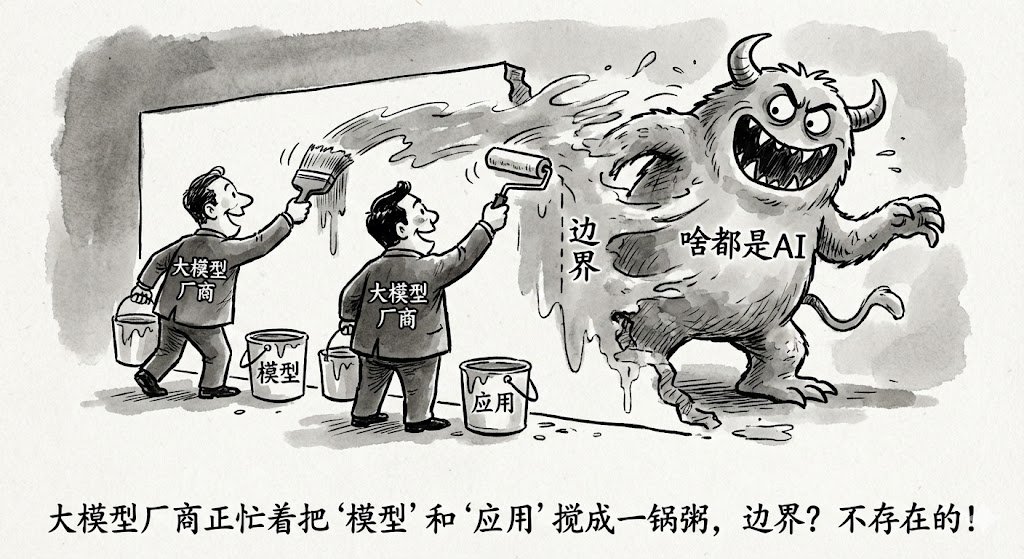
It’s 2025, and you still believe the nonsense that big model manufacturers only do “infrastructure”?
Look at your mobile phone.
The giant that once only provided APIs is now harvesting everything with its own self-assembled "super applications".
Brothers who make thin shells, your "suppliers" are becoming the most terrifying "competitors".
boundary?
What doesn’t exist is the one-size-fits-all approach.
In 2023, we are still discussing "whether the big model is an operating system or a browser." By 2025, the answer has been extremely cruel: they are neither the underlying OS nor the browser at the entrance.
What they want to do is to be a one-stop "super salesperson" that directly takes over the final needs of users.
In the past two years, the veil of tenderness between big model manufacturers and developers, "I provide water and electricity, you build the city," has been completely torn away.
The current situation is that power plants feel that selling electricity is not enough, so they decide to open factories and shopping malls on their own, taking away the business of the small business owners who used to buy electricity.
This "Model as an App" trend is reshaping the entire value chain of the digital economy in an irreversible vertical integration posture.
A look at several landmark events that will occur in 2025 is enough to illustrate it all.
OpenAI, which once promised to "not compete with developers for profits", has directly built-in full-process travel booking and financial management functions in the "GPT-Omni Actions" update launched this year.
It no longer helps you call the API of Expedia or Intel, but allows users to complete all closed loops from price comparison to payment through a deep exclusive agreement in the dialog box.
What kind of "plug-in platform" is this?
It is clearly a super OTA and super bank that does not require downloading and installation.
Looking at Google again, the deeply integrated Gemini in Android 16 is no longer a voice assistant that can be called out at any time, it has actually become a real home screen.
Users no longer need to think about "which app to open to solve the problem", but directly express their intentions to Gemini, and the system automatically schedules the background atomized service capabilities.
For users, the concept of App is disappearing, leaving only the omnipotent Gemini.
This blurring of boundaries is not an accident of technological evolution, but an inevitable necessity of business logic.
When the competition for homogeneous model capabilities intensified, the API economic model that relied solely on selling tokens quickly hit the ceiling.
In order to capture higher profit margins and master the core user behavior data, large model manufacturers must move upstream and enter high-value application scenarios.
For the majority of "shell" entrepreneurs and SaaS companies, 2025 is an extremely painful watershed: if your core value is just to write a few excellent prompts or make a pretty beautiful UI interaction, then you will be powerless to resist.
Because your upstream supplier can now copy your product at zero marginal cost, and has underlying optimization capabilities and traffic entrances that you cannot match.
Large model manufacturers are accelerating their transformation from "technology base providers" to "terminal service operators".
They take advantage of the monopoly advantage of underlying capabilities and blur the boundaries between models and applications through vertical integration strategies.
In essence, they are engaged in a stock game and value harvesting within the ecosystem.
For ecological participants, they must either delve into extremely vertical subdivisions that cannot be easily reached by models, or be prepared to face the dimensionality reduction attack from "Big Brother".
#AI2025 #bigmodel #industryobservation