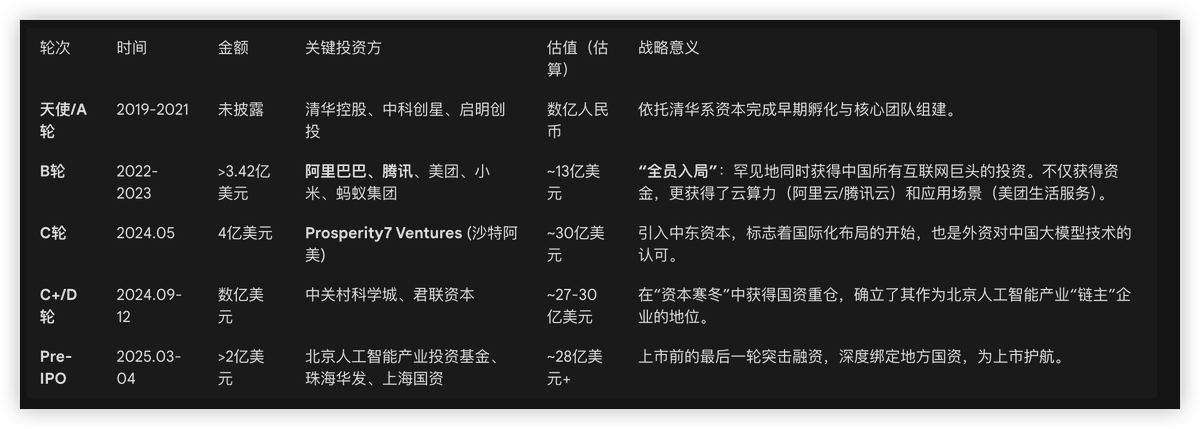
A historic moment for the world's first large model listed company. On January 8, 2026, as the world's first company with large language modeling (LLM) as its core business and listed on the public market, Zhipu's IPO not only marked a substantial breakthrough in the capitalization path of China's "four little AI dragons" (or "AI new tigers"), but also verified to the market the commercial feasibility of a deep integration model based on "industry, academia and research" through its valuation of approximately HK$51.8 billion (approximately US$6.7 billion). The development trajectory of Zhipu is not a typical Silicon Valley-style entrepreneurial story. It was born out of the Knowledge Engineering Laboratory (KEG) of the Computer Science Department of Tsinghua University, and its technical genes are deeply rooted in the academic community's long-term exploration of high-dimensional data mining, knowledge graphs and neural networks. From the construction of the AMiner academic network in 2006, to GLM-130B's technical challenge to GPT-3 in 2022, to AutoGLM's realization of autonomous agent operation on mobile phone terminals in 2025, Zhipu has completed a path from "academic algorithms" to "industrial-grade models" to "general intelligence" Infrastructure" complete evolutionary link. Academic hotbed and technological gene: Tsinghua KEG’s ten-year foundation (2006-2019) The birth of Wisdom AI is not an accidental event, but a natural overflow of the scientific research accumulation of Tsinghua University’s Knowledge Engineering Group (KEG) in the past two decades. To understand the technical background of Wisdom Map, we must go back to the early work of its core founder, Professor Tang Jie, and his team in the fields of data mining and knowledge graphs. This determined Zhipu’s unique “data-knowledge two-wheel drive” route in the later era of large models. AMiner and the construction of large-scale academic knowledge graphs As early as 2006, on the eve of the explosion of deep learning, Professor Tang Jie’s team launched the AMiner (ArnetMiner) project
- This is a system designed to extract and mine large-scale academic social networks. Its core challenge lies in how to extract structured knowledge from massive unstructured texts (papers, citations, author information) and build high-precision scholar portraits and collaboration networks. Technical challenges and breakthroughs: The development of AMiner forced the team to face the challenge of processing large graph data of billions of nodes and edges at an early stage. Professor Tang Jie published a series of foundational papers in the fields of academic social network analysis (Social Network Analysis) and network representation learning (Network Embedding). For example, his research on "Network Embedding as Matrix Decomposition" provided important theoretical support for the subsequent rise of graph neural networks (GNN)5. Accumulation of data assets: AMiner is not only an academic search tool, but also a huge, high-quality knowledge base with rich semantic annotations. This deep understanding of "data structuring" enabled the Zhipu team to have data cleaning and alignment capabilities that surpassed those of ordinary startups when building pre-training data sets. They not only pay attention to the "quantity" of data, but also pay attention to the logical association and knowledge density within the data. Talent reserve: The AMiner project became the training ground for the early core team of Zhipu. As a doctoral student of Professor Tang Jie, Zhipu CEO Zhang Peng was deeply involved in the complete process from theoretical research to system implementation during this period. This dual ability of "scientific research + engineering" has become a typical feature of the Zhipu founding team6. Attempts to integrate knowledge graphs and neural networks In the mid-2010s, with the rise of representation learning technologies represented by Word2Vec and subsequent BERT, KEG Lab began to explore how to combine symbolic knowledge graphs (Symbolic Knowledge) with statistical neural networks (Connectionist Neural Networks). Two-wheel drive concept: Traditional deep learning models are similar to "black boxes", good at perception but lacking logic and interpretability; while knowledge graphs are good at reasoning but difficult to expand. The Zhipu team (which still existed as a laboratory at the time) proposed a fusion idea: using knowledge graphs to enhance the reasoning capabilities of neural networks, and at the same time using neural networks to automatically complete the knowledge graphs. This academic thought directly influenced the design of Zhipu's later CogView and GLM models - that is, the model is not only a generator of statistical probability, but also a generator of statistical probability. It should be an intelligent agent with knowledge retrieval and cognitive abilities. The bud of industry-university-research transformation: In June 2019, in order to transform the laboratory’s achievements in knowledge graphs and large-scale data mining algorithms into actual productivity, Beijing Zhipu Huazhang Technology Co., Ltd. was officially registered and established4. At this time, although Zhipu has not yet set foot in large models with hundreds of billions of parameters, it already has the core algorithm capabilities and computing architecture experience to process ultra-large-scale heterogeneous data. Architectural Innovation and the Establishment of the GLM Paradigm (2020-2022) In 2020, OpenAI released GPT-3. The "emergent" ability of the model with 175 billion parameters shocked the global AI academic community. Facing the technical route monopolized by Google (PaLM/T5) and OpenAI (GPT), Zhipu did not choose to blindly follow the mainstream Decoder-only architecture. Instead, based on academic insights, it proposed and adhered to the **GLM (General Language Model, General Language Model)** architecture. This choice was extremely risky at the time, but ultimately proved to be the Wisdom spectrum is the key to achieving technological breakthrough. Theoretical cornerstone: GLM pre-training framework paper (ACL 2022) The cornerstone of the smart spectrum technology system is laid in the paper "GLM: General Language Model Pretraining with Autoregressive Blank Infilling" published at ACL
- This paper proposed fundamental architectural changes to address the pain points of the pre-training model at the time. Analysis of the limitations of existing architectures. There were three main mainstream architectures in the NLP field at that time, each with its own shortcomings: GPT (Autoregressive): one-way prediction from left to right, good at long text generation, but weaker than the two-way model in natural language understanding (NLU) tasks (such as cloze, classification). BERT (Autoencoding): Bidirectional encoding, good at understanding, but unable to directly generate long text. T5 (Encoder-Decoder): Although it combines the two, it has a huge number of parameters and is less efficient in zero-shot generation tasks. Autoregressive Blank Infilling The core innovation of GLM is to propose a new pre-training objective - autoregressive blank filling. Detailed explanation of the mechanism: GLM randomly digs out continuous segments (Span) in the input text and replaces them with `` tags. The model needs to restore these mined fragments in an autoregressive manner (that is, predicting the next token). Unification of bidirectional attention and unidirectional generation: When encoding the original text after being mined, the model can use the bidirectional attention mechanism (Bidirectional Attention), which means that it can fully understand the context like BERT; and when generating masked content, the unidirectional attention mechanism is used. 2D Positional Encoding In order to better handle the positional relationship between the masked fragment and the original text, GLM introduces a unique 2D positional encoding technology11. Dimension 1: Indicates the global position of the Token in the original input sentence. Dimension 2: Indicates the local position of the Token within the generated mask fragment. Advantages: This design enables the model to maintain accurate perception of location information when processing extremely long contexts or performing complex logical reasoning, significantly improving the coherence of long text generation. GLM-130B: Open source breakthrough with hundreds of billions of parameters (ICLR 2023) In the second half of 2022, Zhipu ushered in the first milestone in its technological development history-the release of GLM-130B. This was China’s first, and at that time the world’s only bilingual bilingual model that was open source and comparable in performance to GPT-3 175B. The Challenge of Training Stability and DeepNorm Training a model with more than 100 billion parameters is extremely challenging in engineering. At that time, both Meta's OPT-175B and HuggingFace's BLOOM frequently encountered training divergence caused by "loss function spikes" during the training process, and had to restart training repeatedly. DeepNorm innovation: Through theoretical derivation, the Zhipu team proposed a new normalization method-DeepNorm. It modifies the initialization method of the residual connection in Transformer, mathematically ensuring the boundedness of the model update gradient as the number of layers increases. GLM-130B successfully expanded to extremely deep network layers without training crashes. This engineering experience was recorded in detail in the ICLR 2023 paper, providing a valuable reference for subsequent large model training. High-precision quantization and hardware democratization The most eye-catching achievement of GLM-130B is its INT4 quantization technology. Background: Typically, running a 175B-level model requires 8 A100 (80GB) graphics cards, which is unaffordable for the vast majority of academic institutions and small and medium-sized enterprises. Technical breakthrough: The Zhipu team discovered that the GLM architecture has unique weight distribution characteristics, allowing the model weights to be compressed into 4-bit integers (INT4) with almost no loss of accuracy (performance degradation <1%). Impact: This breakthrough allows GLM-130B to run inference on servers with 4 RTX 3090 (24GB) or even lower configurations. This "civilian" feature instantly detonated the open source community, making GLM-130B the most popular research base at the time. Construction of bilingual capabilities Unlike GPT-3, which is mainly based on English corpus, GLM-130B uses nearly 400 billion tokens of Chinese and English bilingual data (including The Pile and Wudao Corpora) in the pre-training stage. This gives it an overwhelming advantage in tasks such as Chinese understanding, idiom interpretation, and ancient Chinese translation, while also maintaining top-notch English skills. ChatGLM Series: Opening the Era of Large Model Localization and Inclusive Benefit
- If GLM-130B established the position of Wisdom in the field of high-end scientific research, then the release of ChatGLM-6B completely changed the pattern of open source large models in China, triggering a wave of grassroots innovation in the "Battle of 100 Models". ChatGLM-6B: The revolution of consumer graphics cards On March 14, 2023, on the same day as GPT-4 was released, Zhipu open sourced ChatGLM-6B14. Positioning: This is a miniaturized dialogue model with
- 2 billion parameters, which is deeply optimized for Chinese question and answer and dialogue. Core advantage: Thanks to INT4 quantization technology, this model only needs 6GB of video memory to run smoothly. This means that any individual developer, student or even gamer who owns a mid-range gaming graphics card (such as GTX 1660 or RTX 3060) can locally deploy an AI assistant with acceptable performance. Convenience of fine-tuning (P-Tuning v2): Zhipu has simultaneously open sourced the efficient fine-tuning code based on P-Tuning v2, allowing users to adapt the model to tasks in specific fields (such as law, medical, and two-dimensional role-playing) with very little data and computing power (single card). Community effect: ChatGLM-6B quickly received tens of thousands of stars on GitHub, and its downloads on Hugging Face exceeded one million. It became the “standard base” for fine-tuning and application development of large models in China at that time, greatly lowering the entry threshold for LLM. Rapid iteration: From ChatGLM2 to ChatGLM3, Zhipu has demonstrated an amazing engineering iteration speed. It has released two major version updates in a row in 2023, constantly fixing shortcomings and introducing new features. ChatGLM2-6B (June 2023) Long Context: FlashAttention technology is introduced, extending the context length from 2K to 32K. This enables the model to process long paper summaries or multiple rounds of in-depth conversations in one go. Performance improvement: On evaluation sets such as GSM8K (mathematical logic), the performance has increased by 571%, solving the problem of weak mathematical and logical capabilities of the first-generation model. ChatGLM3-6B (October 2023) Tool Use: This is the biggest qualitative change of ChatGLM3. In the pre-training stage, Intelligent Intelligence has embedded Agent capabilities so that the model can understand and execute "Function Calls". Code Interpreter: ChatGLM3 integrates a code execution environment that can automatically write and run Python code to solve complex mathematical calculations, data analysis or chart drawing tasks. This capability directly benchmarks OpenAI's Advanced Data Analysis function, marking the shift of Zhipu's model from "chat" to "action". Towards general intelligence: GLM-4 and the mixed expert model (MoE) era (2024-2025) Entering 2024, with the further verification of the model scaling law (Scaling Law), a single dense model (Dense Model) encounters bottlenecks in inference cost and performance upper limit. Zhipu has once again made a major upgrade in its architecture, fully shifting to the GLM-4 series and hybrid expert model (MoE) architecture. GLM-4: Benchmarking All-Purpose Tools and GPT-4 In January 2024, Zhipu released GLM-4. This is not just a model, but an ecosystem19. GLM-4 All Tools: This version of the model natively supports parallel invocation of multiple tools. It can automatically plan task chains based on user instructions: for example, "Search for today's weather in Beijing and draw a picture of matching outfits." The model will first call the browser search tool to obtain weather information, and then call the CogView painting tool to generate pictures. This ability to make autonomous decisions is a key step toward AGI. Performance benchmarking: Technical reports show that GLM-4’s scores on mainstream benchmark tests such as MMLU and GSM8K are close to GPT-4 (and GPT-4 Turbo), especially in the instruction following ability (IFEval) in the Chinese context. GLM-4.5: The open source benchmark for MoE architecture In July 2025, Zhipu launched GLM-4.5, which was the most advanced open source MoE model in China at the time20. Architecture Analysis GLM-4.5 adopts a Mixture-of-Experts architecture with a total parameter volume of 355 billion, but during inference, each Token only activates 32 billion parameters (355B Total / 32B Active). Sparse activation principle: The model contains multiple "expert" neural networks. For different input content (such as code, mathematics, literature), the Gating Network will dynamically select the few experts who are best at participating in the calculation. Advantages: This design allows GLM-4.5 to have the knowledge capacity of a very large model (memorized in all parameters), but maintains the inference speed and cost of a medium model. Compared with dense models of the same performance, its inference cost is reduced by about 70%. Open source strategy and MIT protocol Unlike many major manufacturers that only open source small parameter models, Zhipu chose to make the flagship model GLM-4.5 and its lightweight version GLM-4.5-Air (106B Total / 12B Active) completely open source and adopt the extremely loose MIT protocol. This means that companies can commercially use, modify or even use it as the basis for their own closed-source products for free. This strategy is widely considered to be an important means for Wisdom to build a global developer ecosystem and combat the closed-source hegemony of OpenAI20. GLM-4.7 and "Thinking Models" At the end of 2025, Zhipu further released GLM-4.7, focusing on strengthening the model's **Deep Reasoning** capabilities. Thinking Mode: Inspired by models such as OpenAI o1, GLM-4.7 introduces an explicit "thinking" stage. Before answering complex questions (such as difficult mathematical proofs or complex code reconstruction), the model will generate a "Chain of Thought" to perform self-reflection, error correction and planning, and then output the final answer. Preserved Thinking: In multiple rounds of dialogue, GLM-4.7 can preserve the previous thinking process instead of just retaining the conversation history. This is crucial for writing large software codes or performing long logical reasoning, effectively solving the "catastrophic forgetting" problem in long conversations. Multi-modal and embodied intelligence: from talking through pictures to mobile phone avatars. The technical vision of Zhipu has never been limited to text. Through the "Cog" series incubated by KEG laboratory and the subsequent AutoGLM, Zhipu has built a complete technology stack in terms of visual generation and end-side intelligence. CogView and CogVideo: A breakthrough in visual generation CogView: A pioneer in Transformer graphics (NeurIPS 2021) When DALL-E just showed its prominence, Zhipu released CogView. Technological innovation: The paper "CogView: Mastering Text-to-Image Generation via Transformers" proposes to convert images into discrete Token sequences through VQ-VAE (Vector Quantized Variational AutoEncoder), so that the GPT architecture can be directly used for text-to-image generation training. Achievements: CogView achieved a better FID score (a measure of image generation quality) than the original DALL-E on the MS COCO dataset, proving the potential of the general Transformer architecture for cross-modal generation. CogVideoX: Overcoming the physical consistency of video generation (ICLR 2025) In 2024-2025, video generation becomes a hot topic. Zhipu launched the CogVideoX series. 3D Causal VAE: In order to solve the problem of poor action coherence in video generation, CogVideoX designed a 3D causal variational autoencoder. It not only compresses images spatially, but also compresses them in the temporal dimension, ensuring a logical causal relationship between video frames (that is, the next frame must evolve from the previous frame, rather than being generated out of thin air). Expert Transformer: Expert Adaptive LayerNorm is introduced in the Transformer layer, allowing text commands (Prompt) to more accurately control object movement and scene changes in the video. AutoGLM: From “Chatbot” to “Phone Agent” From the end of 2024 to 2025, Zhipu released a highly disruptive product-AutoGLM, which marked its strategic focus from MaaS (Model as a Service) to AaaS (Agent as a Service). Mobile phone operating agent AutoGLM is not a simple chat robot, but a GUI agent that can take over control of a mobile phone. Technical implementation: AutoGLM is based on the multi-modal large model (GLM-4V) and can "understand" pixel-level information (such as icons, buttons, text layout) on the mobile phone screen. It sends commands such as clicks, slides, and inputs through the Android Debug Bridge (ADB) interface or system accessibility service (Accessibility Service). Application scenario: Users only need to say "order a cup of Luckin coffee for my mother", and AutoGLM can automatically open the takeout software, search for stores, select products, fill in the address and submit the order. It breaks down the barriers between apps and realizes cross-application automated processes. Significance: This is a software-based dimensionality reduction attack on hardware routes such as Rabbit R1 and AI Pin. It does not require users to purchase new hardware and can turn existing mobile phones into true AI assistants. The road to capitalization: Financing process and IPO (2019-2026) Zhipu’s financing history is the epitome of the wind vane of China’s primary market. It has gone through a complete cycle from early venture investment, to strategic investment by Internet giants, to the entry of the “national team”. Detailed analysis of the financing process. As of before its listing, Zhipu AI’s cumulative financing amount exceeded US$1.5 billion (approximately RMB 10 billion), and its valuation soared from tens of millions of US dollars to nearly US$7 billion. The last round of surprise financing before the listing deeply binds local state-owned assets to protect the listing. Hong Kong IPO: The first large-scale model stock in the world. On January 8, 2026, Zhipu AI officially landed on the Hong Kong Stock Exchange. Fund-raising scale: Plans to raise approximately US$560 million to US$640 million (approximately HK$4.35 billion). Valuation: The market value of the issuance is approximately HK$51.8 billion (approximately US$6.7 billion). Market position: Zhipu completed the listing before OpenAI, Anthropic and domestic competitors MiniMax and Moonshot, becoming the world's first publicly listed large model company. This not only solves the financial anxiety caused by the high R&D costs of large models, but also leads its competitors in terms of brand trust - for large B-side customers, the financial transparency and viability of listed companies are more guaranteed3. Business model verification The prospectus disclosure shows that Zhipu’s revenue structure has begun to take shape: MaaS (Model as a Service): charges through API calls, serving tens of thousands of small and medium-sized developers. Privatized deployment: Provide localized training and deployment of GLM models for large customers in finance, government affairs, energy, etc. who are extremely sensitive to data security (such as major banks and state-owned enterprises). This is Zhipu’s core moat compared to foreign companies such as OpenAI in the Chinese market. C-side subscriptions: Although the membership subscription revenue of the Zhipu Qingyan App is relatively small initially, with the addition of AutoGLM and other functions, there is huge growth potential. From the laboratory code on the Tsinghua campus to the ringing of the bell at the Hong Kong Stock Exchange, Zhipu AI has gone through a road of technology entrepreneurship with Chinese characteristics. Technical autonomy: Zhipu has proven that the Chinese team does not rely on Western open source architectures such as LLaMA, and is fully capable of building a world-class GLM pre-training system from scratch, and can keep pace with or even lead in cutting-edge fields such as MoE and long context. Open source ecosystem builder: Through the continuous open source from ChatGLM-6B to GLM-4.5, Zhipu has actually become the "base" of China's large model ecosystem. This strategy of "exchanging open source for ecology and using ecology to promote business" has allowed it to gain a firm foothold in the fiercely competitive battle of hundreds of models. The next stop on the road to AGI: With the injection of listing funds, the strategic focus of Zhipu (now renamed Z.ai) has clearly shifted to embodied intelligence (AutoGLM) and super reasoning (Thinking Models). The competition in the future will no longer be purely about the number of parameters, but about who can make AI truly "think like a human" and "complete work for humans." The listing of Zhipu is not only a milestone for a company, but also a footnote of the era when large model technology has moved from "fanatical bubble" to "industrial implementation". It indicates that the AI industry will enter the deep water zone - the competition will be the stability of engineering implementation, the hematopoietic ability of business models, and the ability to continue innovation in the context of a shortage of computing power.