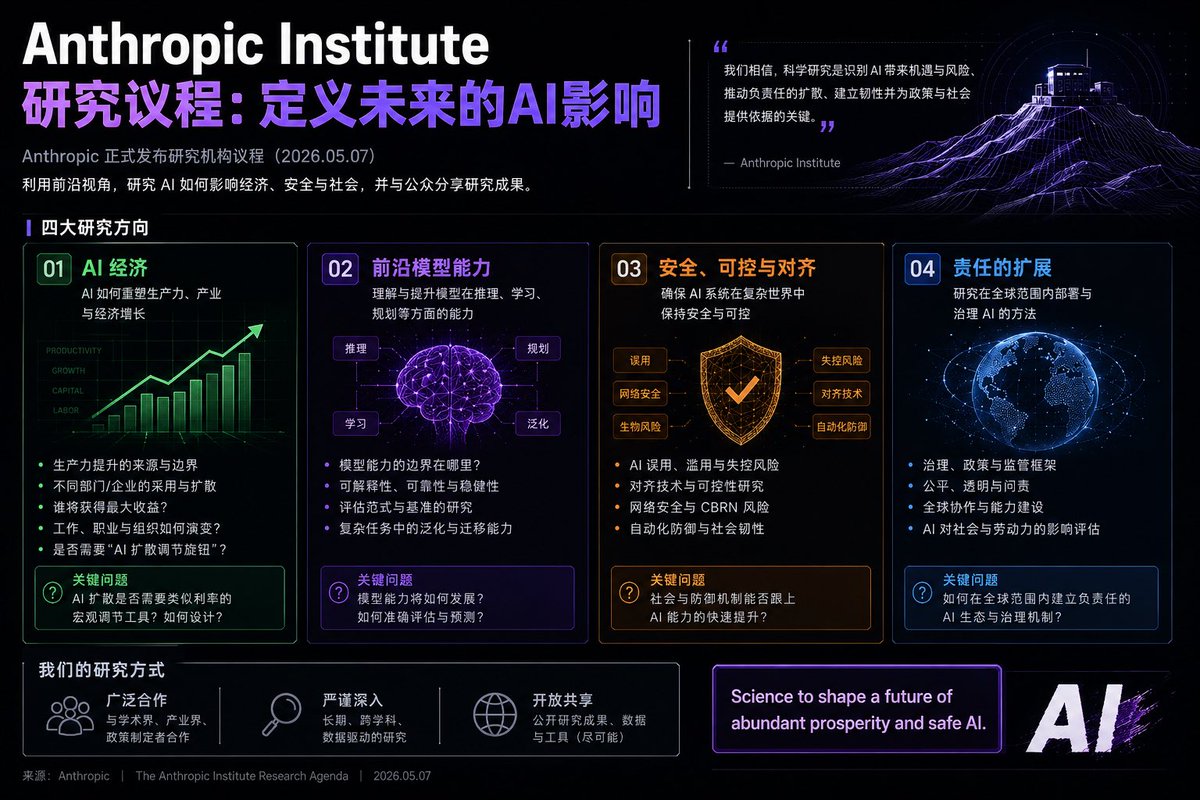
Anthropic has just published a very important research agenda.
AI is now a systemic issue of economic diffusion + security resilience + social governance + accelerated scientific research.
Anthropic breaks down the most critical questions of the next few years into four directions: 1) How does AI spread️ into the economy?
Who will be the first to adopt AI?
Which companies, cities, countries can really capture the AI dividend?
What would happen to the industrial organization if a team of 3 people could do what a team of 300 did in the past?️ 2?
What new threats would AI pose?
Cyber, bio, surveillance, automated attacks… the real question is not whether AI is at risk, but whether social defense mechanisms can keep pace with advances in AI capabilities.
3️ ³ How will AI change people in the real world?
When a large number of people start relying on the same batch of models, our judgment, writing style, belief structure, and organizational collaboration will all be quietly reshaped.️ 4 Will AI accelerate AI's own research and development?
This is the deepest water area.
What kind of telemetry, fire drill and governance do we need if AI starts to get involved in developing the next generation of AI?
I think the most important thing about this article is that AI becomes a new kind of social infrastructure to study.
What's really scarce next: the observability of AI-driven R&D by 📊 early signal 🛡️ society resilience ⚖️ 🔬 diffusion regulation mechanisms and 🧠 human expert growth pathways