In the afternoon, I was surprised when I saw the news about the layoffs of a large factory posted by @MaxForAI, and then I sent a private message to verify it.
I still believe Max’s source.
The wheel of an era rolls forward, and in the dust raised are all living beings, and we are all one of them.
I voluntarily chose to leave a big factory about 5 years ago.
My current situation is so-so, and my physical and mental state are much better.
The following paragraph is an article I wrote at the beginning of 2024, and I posted it today because of my thoughts.
Welcome to communicate with me in the comment area.
Note⚠️: The following content was written in February 2024, and some of the information has now changed.
As a member of the Dachang years, I am familiar with the jargon mentioned in the movie such as "pull through", "closed loop", "empowerment", "alignment", "grasp" and so on.
I once suspected that I should study Chinese specifically.
I would spend 2 to 3 months every year preparing materials for promotion and year-end performance.
I also spend a lot of energy to provide ammunition to my superiors, and my posture must be comfortable.
This is like the young dragon-slaying boys who originally formed a team to fight the evil dragon, but found out halfway through that there was a kingdom of girls.
Well, as soon as the dragon-slaying knife was thrown away, it started to be a fight between each other.
In fact, even when the industry is doing well, it doesn't matter anymore, everyone is doing something.
The golden decade, the giant whale that sprays water.
The decade from 2010 to 2020 is considered the golden decade of the Internet industry.
Big players like Google, Meta, Alibaba, and Tencent are like a group of giant whales churning in the digital ocean.
Rainbows can be seen in the spray.
The profit models of these companies, simply put, are: Google makes money from search advertising, Meta makes money from social network advertising and user data, Alibaba makes money from e-commerce and cloud computing, and Tencent makes money from gaming, social networking, and advertising.
These models keep guys' wallets bulging.
Slowly, like a ship that has been sailing on the sea for a long time, the bottom of the ship begins to grow with seaweed.
Organizational structures become as complex as a maze, decision-making processes slow to a snail's pace, and internal struggles and conflicts of interest cause headaches.
So, I'm going to conduct a thought experiment, an exploration.
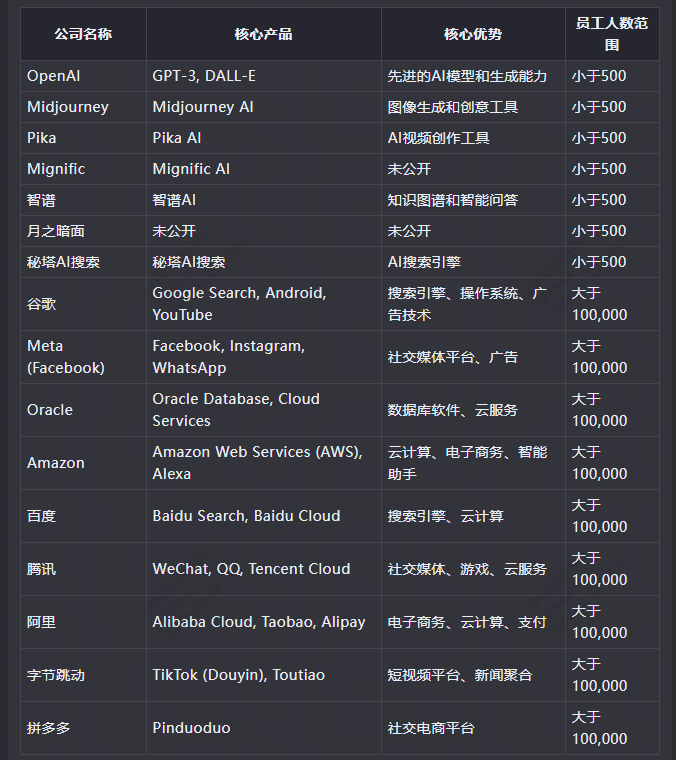
I used Kimi from Dark Side of the Moon to help compile a table.
This company just raised $1 billion in financing.
In less than 3 minutes, the results came out.
Take a look: Please note that the following information is based on data as of the deadline of my knowledge (April 2023) and may be subject to change.
Headcount, user and revenue data may need to be obtained from official channels or the latest financial reports.
In addition, the number of employees and users of some companies may not be publicly disclosed.
The following is a table compiled based on the available information: OpenAI is coming.
In 2022, OpenAI slowly began to make its way out of the AI industry, and then shocked everyone every few months.
GPT3.5, GPT4, OpenAI Gongdou, GPTs, Sora...
In 2022, OpenAI achieved the feat of accumulating 100 million users in 2 months, which is unprecedented and unprecedented (or it may happen soon).
It is said that the average salary of OpenAI employees is 90W US dollars per year.
Based on 500 employees, the monthly salary expenditure is approximately 300 million yuan (RMB).
However, OpenAI’s actual expenditure is about one-third, and the remaining two-thirds are options and the like.
However, once again, Microsoft said during a few months of court battle that it could give every OpenAI employee an offer of equal value.
We know that OpenAI has a per capita scientist + research institute level.
Although they have experienced a thrilling "palace fight" not long ago, they feel that they have become more united and agreed that "what can't kill me makes me stronger".
Within two months, they launched GPTs and Sora, and Ultraman boasted a seven trillion plan.
What kind of magic makes OpenAI so effective and productive?
Let’s take a look at their organizational structure first: OpenAI operating model: I have thought hard for a long time, and maybe I can get some clues from the attendance sheet below.
The following is an unpretentious day of an OpenAI engineer: The shackles of the old model.
The plates of major manufacturers are too big.
If the elephant wants to turn around and dance, it is not easy.
As technicians, most of us are very honest.
Even if the two departments fight fiercely, after communicating with each other privately, we find that everyone is the same, because most of the classmates who do things are very good and don't have so many twists and turns.
The organizational structure design of Dachang 20 years ago determines the inevitable layer-by-layer exploitation of interests.
After obtaining unearned benefits through bugs in the organizational structure, will you still think about poetry and the distant future?
In the past, small companies had flexible structures, high efficiency, and quick response, but they could not do platform-level things.
To develop infrastructure platforms such as e-commerce, live streaming, payment, etc., you can only rely on the accumulation of people, and it is redundant tactics, fatigue tactics, and crowd tactics.
More and more OpenAIs.
So what now?
The post-GPT era has only passed for about two years, and we have seen many outstanding companies like MJ, Magnific, Pika, Dark Side of the Moon, and Wisdom.
They are all small in scale, but in terms of AI market share, their combined total is greater than that of the "big companies".
On the one hand, in today's era, it is possible to create excellent AI products by gathering a few like-minded AI scientists, researchers and an excellent AI product manager.
The interaction mode of the product is no longer important.
What is important is whether the product itself is good enough.
Whether it is a chat box, a web interface or each "/" character, this is not important.
This is also the reason why many small-scale AI companies choose to open Channels on discrod, because the core competitiveness is what comes after "/".
You can just build your own website when you have the time.
The advent of the AI era and the curtain call of traditional large companies.
When small companies become towering trees, they cannot avoid bloat, inefficiency, and internal friction.
Perhaps the following picture can explain part of the reason: It is not so easy for a mature enterprise to find the second S-shaped curve.
Even if it is found, it is even more difficult to implement!
As long as humans exist, human nature will exist, and some problems will remain unsolvable.
However, the emergence of AI has the potential to change the situation.
The arrival of the AI era will give high-quality small businesses an opportunity: that is, they no longer need to expand their scale to improve efficiency.
What you need may just be a handy AI platform or tool to verify your idea and launch it online within 15 days.
You don’t need to coordinate across departments, re-set KPIs or OKRs, do more than ten rounds of reports, stay up all night for project approval materials, and finally tell you to do it again.
For an aircraft carrier-level company with 100 times its staff size, it may have to wait at least 150 days.
The doubling of scale will also lead to a rapid decrease in efficiency.
Let me boldly say that the arrival of the AI era is the beginning of the curtain call for the "big companies"...
One possibility is that the arrival of the AI era has given more individuals and small businesses the opportunity to "".
Maybe most small businesses will not have scientists or researchers like Dark Side of the Moon and Pika, and cannot make AI tools.
For ordinary small businesses, these state-of-the-art AI tools can be directly used to accelerate the commercialization of the enterprise.
A good CEO of a small business in the AI era should have a high probability of using AI tools to create products that are as good as those of big manufacturers, especially those small business scenarios that big companies look down on and are unwilling to invest in.
Similar to the birth of PDD and the birth of Toutiao.