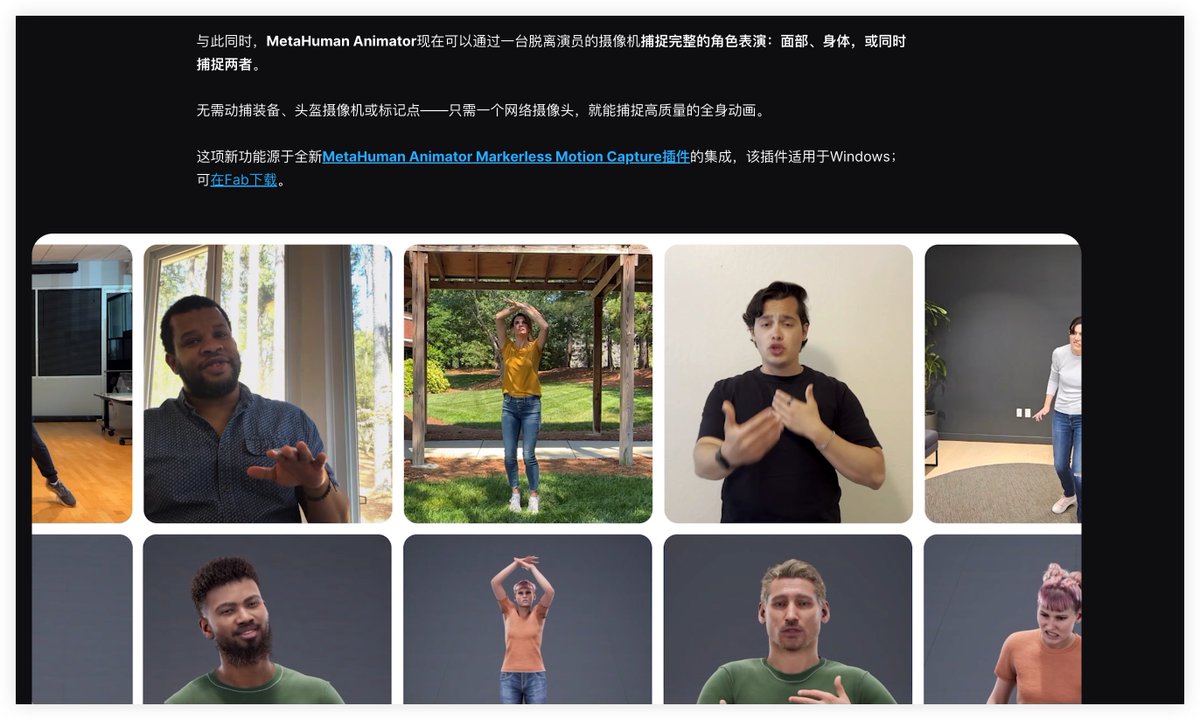
The camera motion capture function of unreal engine 5.8 is amazing! In the past, to achieve high-quality digital human performance capture, the face and body were usually processed separately. The face may use iPhone TrueDepth and a head-mounted camera, and the body may require a motion capture suit, an optical motion capture booth, marking points, and multiple cameras, and then be cleaned, bound, redirected, and synthesized. UE 5.8 compresses the process this time: an ordinary off-body camera, or even a webcam, can capture body movements from standard video, and can also capture facial and body performances simultaneously. Epic’s official description clearly mentions that MetaHuman Animator can now capture face, body, or both from a single off-actor camera, eliminating the need for mocap rigs, helmet cameras, or markers. A typical process is roughly as follows:
- First use a mobile phone, camera or webcam to record the actor's performance; 2 Then import the footage through Live Link Hub / Capture Manager in Unreal Engine; 3 Then create a MetaHuman Performance asset and choose to solve the body, face or both; 4 The system batch-processes the video locally and outputs the Animation Sequence; 5 Finally, apply the animation to MetaHuman and put it into the Level Sequence to continue editing, correction and rendering. Epic documentation breaks this process into three steps: import footage, process and export animation, and preview to MetaHuman. It's not a replacement for real-time motion capture just yet. The document is very clear. This mono video capture process is a local batch process, used for high-quality offline results; if you want real-time face capture, you need to look at MetaHuman's realtime animation related process. The plug-in itself is also Experimental, which means that the API, stability, output quality, and workflow details are subject to change later. There are many suitable usage scenarios. The first category is short videos, virtual human content, and AI character videos. For example, a team wants to use digital humans to explain products, courses, and news interpretations. In the past, it required real people to appear or complex motion capture. Now, actors can use their mobile phones to record a full-body performance, and then migrate the movements to MetaHuman. Face, body, and gestures can be entered into UE together, making it suitable for virtual hosts, enterprise digital employees, and knowledge IP. The second category is the rapid production of game NPCs and plot animations. When small and medium-sized teams are doing RPG, interactive narrative, and open world side missions, the most expensive thing is the large number of characters standing, talking, turning, pointing, and expressing emotions. Now you can use ordinary cameras to quickly capture actor performances, generate usable MetaHuman animations, and then modify them in Sequencer or Control Rig. It does not necessarily directly replace the AAA-level motion capture studio, but it is very suitable for blocking, previs, branch NPC performances and medium-precision plot animation. The third category is film and television previews and virtual production. The director or action director can first use ordinary video to capture the actor's movements, body rhythm and performance intentions, and then quickly put it into the UE scene to see the lens, lighting, composition and editing rhythm. It is especially valuable for commercials, short films, and virtual shoot previews because it reduces the cost of "first trial version." The fourth category is AI Agent + 3D content production pipeline. For example, in the future, a content production agent receives a task: "Generate a 30-second video of a MetaHuman product manager introducing new features in the office." Agent can generate scripts, TTS, shot lists, and character settings; real-life or synthetic videos provide action references; UE
- 8's markerless mocap converts videos into character animations; and finally, it automatically enters Sequencer for rendering. This type of capability will allow a more controllable industrial path beyond "text to video": text drives scripts, video drives actions, and UE is responsible for characters, lighting, scenes, and final rendering. The fifth category is enterprise-level training and simulation. For example, safety training, customer service training, medical communication, and sales drills often require a large number of character movements and expression scenes. In the past, it was too expensive to find animators to create each scene. Now, character movements can be quickly generated through ordinary shooting, and then these animations can be put into the interactive training system. For the B-side, its value lies in reducing content update costs. The sixth category is UGC/independent creator workflow. As long as an individual creator has a Windows workstation, UE
- 8, MetaHuman, and an ordinary camera, he can convert his performance into a digital human animation. For YouTube, Bilibili, X Video, virtual anchors, and independent game demos, this will significantly lower the threshold for "looking like industrial-grade character animation".