Working Notes on Agent Systems/Brad Zhang

@teach_fireworks / X longform

I ran a relatively simple mechanism for freely selecting model routing locally. After running it for a while,

I ran a relatively simple mechanism for freely selecting model routing locally. After running it for a while, I felt that it was still useful and could be further...

July 7, 2026 · 1 min read

I ran a relatively simple mechanism for freely selecting model routing locally. After running it for a while,
Figure 1 / source image

I ran a relatively simple mechanism for freely selecting model routing locally. After running it for a while, I felt that it was still useful and could be further polished. Especially when there are long and complex tasks, it is a good way to dynamically select models based on complexity. Agents and people who use the model should be familiar with the characteristics, strengths, weaknesses, costs, and new features of each model. The mechanism is roughly as follows:

  • Tasks are first scored according to complexity, reversibility, verifiability, context size, and user impact. 2 Use tools first if they can be solved with tools, such as rg, scripts, tests, lint, schema validation, and API readback. 3 Verifiable search, extraction, formatting, and file inspection take the mini/low-cost route.
  • Partial code modifications and document rewriting are carried out in the medium model or the current main agent. Only upgrade to high inference models for architectural risks, high impact releases, permission/production/money related, low verifiable judgments.
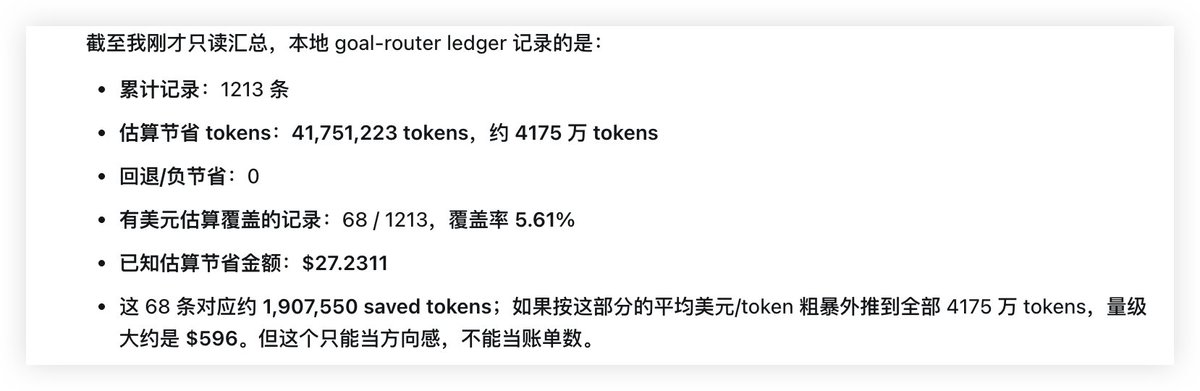
  • Every time you bypass the baseline of "full high configuration model", write the estimated difference to: ***/.goal-router-state/*/savings-ledger.json

Visual summary

Article argument map

Generated from the post's content graph

FORMATTOPICCAPABILITYMARKETcoverscoverscoverscoverscoverssignalssignalssignalsFORMATlongform noteTOPICagentsTOPICharness engineeringTOPICtechnical distributionTOPICmemoryTOPICinferenceCAPABILITYagent workflowCAPABILITYevaluationCAPABILITYproduct surface
Mermaid outline
flowchart LR
  format-long_post["longform note"]
  topic-agents["agents"]
  topic-harness-engineering["harness engineering"]
  topic-technical-distribution["technical distribution"]
  topic-memory["memory"]
  topic-inference["inference"]
  capability-agent-workflow["agent workflow"]
  capability-evaluation["evaluation"]
  capability-product-surface["product surface"]
  format-long_post -->|covers| topic-agents
  format-long_post -->|covers| topic-harness-engineering
  format-long_post -->|covers| topic-technical-distribution
  format-long_post -->|covers| topic-memory
  format-long_post -->|covers| topic-inference
  format-long_post -->|signals| capability-agent-workflow
  format-long_post -->|signals| capability-evaluation
  format-long_post -->|signals| capability-product-surface

Visual structure

Essay structure map

Built from summary and key paragraph positions

I ran a relatively simple mechanism for freely selecting model routing locally. After...THESISI ran a relativelysimple mechanism forfreely selecting modelrouting locally. AfterSIGNALI ran a relativelysimple mechanism forfreely selecting modelrouting locally. AfterOPERATOR4. Partial codemodifications anddocument rewriting arecarried out in theIMPLICATION5. Every time youbypass the baseline of"full highconfiguration model",
Mermaid outline
flowchart LR
  thesis["I ran a relatively simple mechanism for freely selecting model routing locally. After running it for a whil..."]
  signal["I ran a relatively simple mechanism for freely selecting model routing locally. After running it for a whil..."]
  operator["4. Partial code modifications and document rewriting are carried out in the medium model or the current mai..."]
  implication["5. Every time you bypass the baseline of \"full high configuration model\", write the estimated difference to..."]
  thesis -->|frames| signal
  signal -->|develops| operator
  operator -->|lands in| implication

Source: View the original post