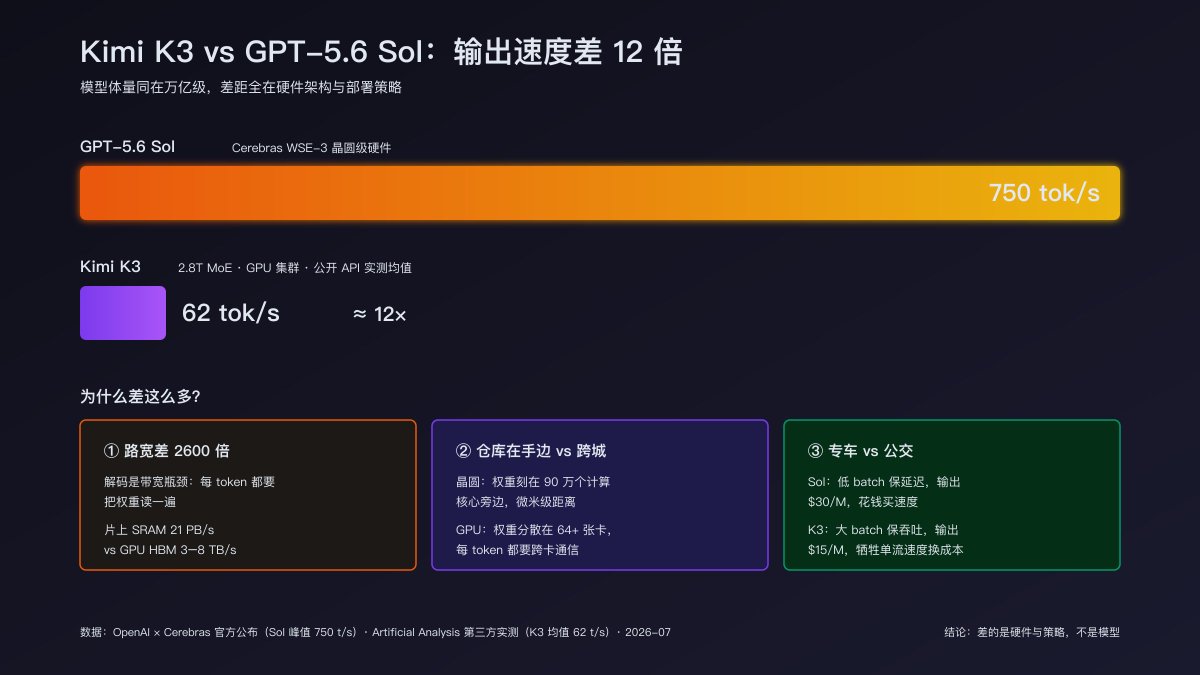
The output speed of GPT 5.6 sol is approximately 12 times that of Kimi K3! Everyone feels that K3 is much slower than GPT 5.6 sol. This is indeed the case in my experience, and it is not even a little bit slower. Here are the specific reasons why: • GPT-5.6 Sol tops out at 750 tokens/s, running on Cerebras wafer-scale hardware (WSE-3), which is nearly an order of magnitude faster than leading-edge models deployed on conventional GPUs (~40–150t/s). GPT-5.6 Sol was exposed to model parallelization across about 100 wafers, but the fabric bandwidth between wafers is 214 Pb/s, which is several orders of magnitude higher than the NVLink/InfiniBand of the GPU cluster, and the communication overhead accounts for a small proportion. • Kimi K3 is about 62 tokens/second (average third-party measurement), which is in the bottom third of the Artificial Analysis speed list. K3 is a super large MoE model with 2.8T parameters and is not designed for extreme speed output. The weight cannot be put into a small number of GPUs. The official recommendation is to deploy super nodes with more than 64 cards. Experts bring a large amount of cross-card communication in parallel. • Service strategy: 62 t/s on the public API is the single-user speed under shared cluster and large batch running throughput - GPU service providers will sacrifice single-stream speed for total throughput in order to spread costs. Sol's 750 t/s is a "low-latency lane" specially opened by OpenAI (it is still open in limited quantities at the beginning), using small batches in exchange for speed. If you change the production scheduling strategy for the same model, the numbers will be several times different. Core differences: Both models are about the same size, both more than 2T. • K3 runs on a GPU cluster: the weights are stored in the video memory (HBM), "a city away" from the computing core. Every time a token is generated, 1.4TB of goods must be transported through the "highway" with a bandwidth of about 3-8 TB/s. Moreover, the model is too large to fit on several cards and is scattered on 64 cards. Several "cross-city coordination meetings" (communication overhead) are held between cards for each token. • Sol runs on Cerebras wafers: the weights are engraved directly next to the compute cores, 44GB of on-chip SRAM is just microns away, and the bandwidth is 21 PB/s—more than two thousand times wider than a GPU. The cargo weighs the same, but the road is two thousand times wider, so the speed is naturally an order of magnitude faster.
Visual summary
Article argument map
Generated from the post's content graph
Mermaid outline
flowchart LR
  format-article["article feature"]
  topic-memory["memory"]
  topic-inference["inference"]
  topic-retrieval["retrieval"]
  capability-product-surface["product surface"]
  market-open-source-builders["open-source builders"]
  format-article -->|covers| topic-memory
  format-article -->|covers| topic-inference
  format-article -->|covers| topic-retrieval
  format-article -->|signals| capability-product-surface
  format-article -->|signals| market-open-source-builders
Visual structure
Essay structure map
Built from summary and key paragraph positions
Mermaid outline
flowchart LR
  thesis["The output speed of GPT 5.6 sol is approximately 12 times that of Kimi K3! Everyone feels that K3 is much s..."]
  signal["The output speed of GPT 5.6 sol is approximately 12 times that of Kimi K3! Everyone feels that K3 is much s..."]
  operator["The output speed of GPT 5.6 sol is approximately 12 times that of Kimi K3! Everyone feels that K3 is much s..."]
  implication["The output speed of GPT 5.6 sol is approximately 12 times that of Kimi K3! Everyone feels that K3 is much s..."]
  thesis -->|frames| signal
  signal -->|develops| operator
  operator -->|lands in| implication